Pickleball terms explained: kitchen, dink, side out and more
Look up the pickleball words you hear during a game, with short examples for shots, kitchen rules, serving turns and score calls.
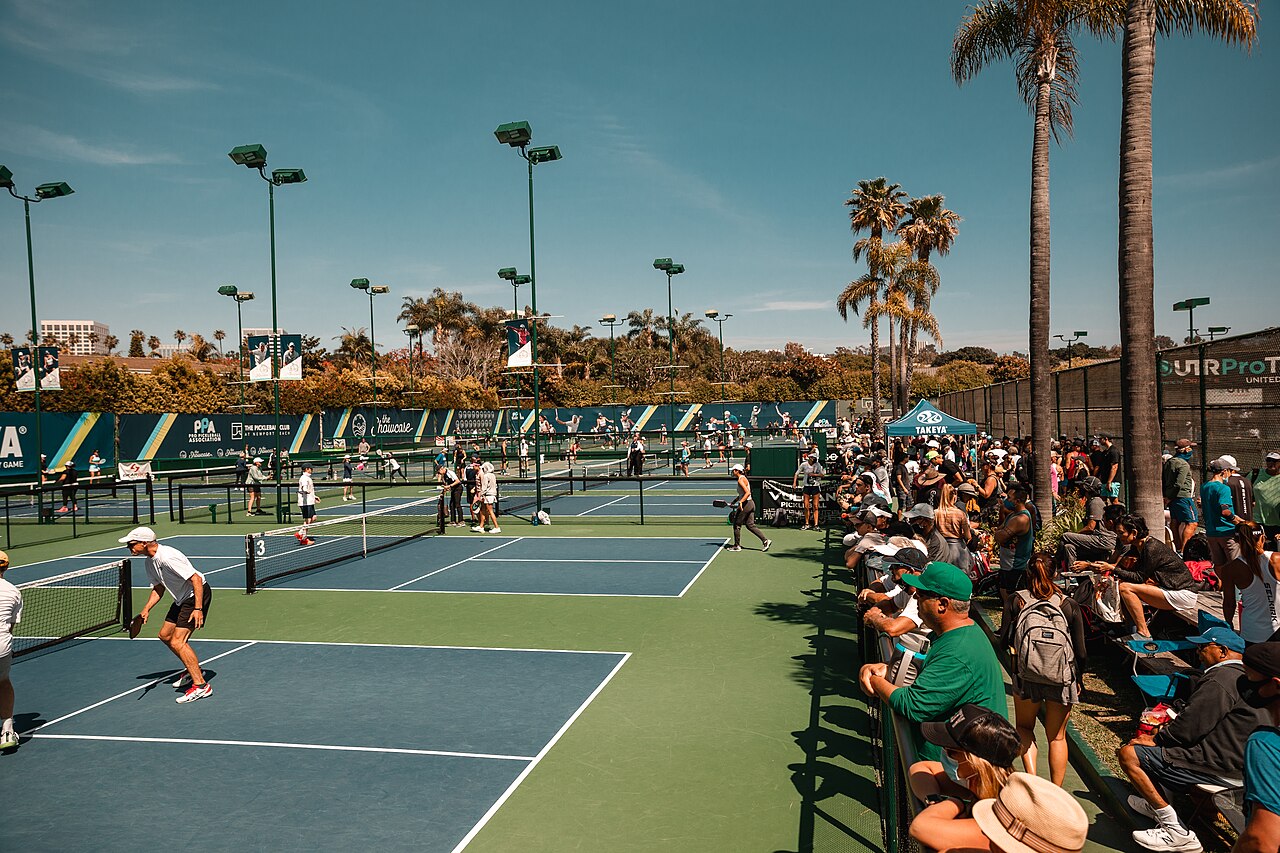
The kitchen is the non-volley zone, a dink is a soft shot near the net, and a side out gives the serve to the other team. Use this glossary to look up pickleball terms you hear during a game.
These are plain-language explanations of rules and coaching vocabulary. For the complete playing sequence, use the pickleball rules guide.
Court and contact
Kitchen or non-volley zone (NVZ)
The kitchen is the area extending 7 feet from either side of the net, including its boundary lines. You may enter it to play a bounced ball. You cannot volley while touching it, or let your volley momentum carry you into it, even after the rally ends. For example, stepping in to lift a short bounced ball is legal. Stepping onto the kitchen line while volleying is a fault. USA Pickleball's kitchen guidance explains the restriction.
Service court
A service court is one of the two boxes between the kitchen and baseline at each end. The centerline divides the right and left boxes. Your diagonal serve lands deep inside your opponent's right service court.
Serving area
The serving area is behind the baseline, between the imaginary extensions of the centerline and sideline. Before serving from the right, for example, you set up behind the right half of the baseline. See the court areas in the 2026 rulebook, section 3.
Line call
A line call decides whether a ball landed in or out. A ball touching a court line is generally in; a serve touching the kitchen line is a fault. A rally shot clips the baseline and stays in, but a serve clipping the kitchen line is short. See USA Pickleball's line-call guidance.
Volley
A volley means hitting a ball before it bounces. After the opening bounces, you block an opponent's drive out of the air while standing behind the kitchen line.
Groundstroke
A groundstroke is a shot you hit after the ball bounces. You let a deep return bounce, then hit a forehand from near the baseline. See the contact terms in USA Pickleball's basic terms guide.
Two-bounce rule
The serve must bounce before the return, and the return must bounce before the serving team hits it. Then volleying is allowed. This does not mean waiting for two bounces on one side. You serve, your opponent returns after a bounce, and you let that return bounce before hitting shot three. See the two-bounce summary.
Shots
These are common coaching terms. USA Pickleball's basic terms guide covers the soft shots, lobs and smashes below.
Dink
A dink is a gentle shot off a bounce near the kitchen that aims to land in the opponent's kitchen. At the kitchen line, you let a low ball bounce and send it softly crosscourt into the opposite kitchen.
Drop or third-shot drop
A drop is a soft shot from farther back that aims to land in the kitchen. A third-shot drop comes after the serve and return. A deep return keeps you back, so you arc your next shot into the kitchen and have time to move forward.
A drop serve is different: the server lets the ball bounce before striking the serve.
Drive or third-shot drive
A drive is a firm, fast shot. A third-shot drive is the serving team's drive after the return. You let a short return bounce, then hit hard through the middle. A third shot can be a drop or a drive; see USA Pickleball's comparison.
Lob
A lob sends the ball high over an opponent and toward the back of the court. Both opponents are close to the kitchen, so you loft the ball over their paddles toward the baseline.
Overhead smash
An overhead smash is a hard shot hit above your head and down into the other court. An opponent's lob falls short, and you hit it downward into open space.
Serving and scoring
The first-server, second-server and three-number calls below describe standard doubles with side-out scoring. The rally-scoring option uses a different format.
Serve
The serve starts the rally and travels diagonally into the opposite service court. From your right serving area, you serve across to the receiver's right service court.
Return of serve
The return is the receiver's reply to the serve, after it bounces. You return a serve deep toward the serving team's baseline. USA Pickleball's beginner vocabulary covers both shots.
Rally
A rally is the play that begins with the serve and ends when the ball is dead. A serve, return, drop and several dinks all belong to the same rally.
Fault
A fault is a rule violation that ends the rally. Your drive lands beyond the baseline, so your team loses that rally. See the fault summary.
Side out
A side out transfers the serve to the opponents. In standard doubles, your team's second server loses the rally, so the other team serves next.
Side-out scoring
Only the serving side can add a point. Suppose your team has 4 points and the serving team has 6. You win a rally as receivers. Your score stays 4; the result affects who serves next. USA Pickleball's scoring summary distinguishes this from rally scoring.
Rally scoring
The rally winner scores, whichever side served. The 2026 USA Pickleball rulebook includes a provisional rally-scoring option with a two-number doubles call: server's score, then receiver's score. If your team has 4 points and wins a rally while receiving, its score rises to 5. Event formats vary, so check the organizer's scoring rules. See rule 14.A.
First server and second server
These labels describe partners' turns in a standard doubles service rotation. After a side out, the correctly positioned player on the right serves first; the partner serves second. Alex serves first, loses a rally, and Sam takes over as second server. The opening rotation has the exception below.
Server number
The last number in a standard doubles score call tells you whether this is the first or second server's turn. It is not a permanent player number. For example, "4-2-1" means the serving team has 4 points, the receivers have 2, and the first server is serving.
0-0-2
Standard doubles starts at "zero, zero, two" because the opening team gets only one server before a side out. Alex starts at 0-0-2 and loses the first rally. The serve goes to the opponents, rather than to Alex's partner. The 2026 rulebook, sections 5 and 6 covers the exception and score calls.
Using the terms at your next session
If a session listing mentions a skill level alongside these shots, check what the host expects you to do consistently. Our pickleball ratings guide explains the language used for levels and event entry. Before the first serve, agree on the scoring format with the other players.
Your next match
Ready to improve your game?
Download Racketly for iOS, Apple Watch or Android and start tracking your matches today.
Choose your Racketly download or read the match tracking guide.